







Economic Shift & Opportunity: Why this is the Moment

Author:  Marlo Weekley

Date Published: April 7, 2026


Economic Shift & Opportunity: Why this is the Moment

         In 2026, we’re watching a shift from land as a passive asset to land as an actively designed system. Land assets are being brought to the drawing board to strategize how they can produce ecological, financial, and cultural value all at the same time. In a moment marked by economic uncertainty and recession risk, this is not where most people expected innovation to surge. And yet, here we are, reshaping the ground layer of the economy itself.

        Part of what’s driving this shift is simply reality catching up with us. Soil degradation, water scarcity, and climate volatility are no longer abstract. They are material financial risks showing up in supply chains, insurance models, national policy, and even homeowners. In the United States alone, over $1 billion in new federal investments has been directed toward regenerative practices. Certified regenerative land in the U.S. has exploded from less than 1 million acres in 2021 to approximately 25 million acres today.

A dense forest canopy viewed from above, featuring various shades of green foliage and dappled sunlight.

       This moment is not random. It is the result of multiple systems reaching limits at the same time. First, the economic layer is under strain. Land has traditionally been valued through extraction or appreciation, but both models are showing volatility. Input costs in conventional agriculture have risen significantly over the past few years, from fertilizers to fuel, while environmental costs to these methods become more actual. At the same time, insurance markets are reacting to climate risk. In some regions, coverage is becoming more expensive or harder to secure altogether. This changes the equation. Stability, not just yield, becomes valuable. Regenerative systems are gaining attention because they reduce dependency on external inputs and increase on-site resilience.

A winding dark stream meanders through a vibrant, lush green wetland landscape viewed from directly overhead.

         Second, climate risk has crossed into financial reality. This is a major inflection point. Droughts, floods, and erratic weather patterns are no longer edge cases. They are baseline conditions in many regions. For investors and landowners, this translates into inconsistent returns and long-term uncertainty. Regenerative land systems, particularly those focused on soil health and water retention, are being evaluated as risk management tools. Healthy soil acts as a buffer, holding water during drought and absorbing excess during heavy rainfall. That functional resilience is now being priced into decision-making.

         Third, policy and capital are aligning in a way they have not before. Governments are beginning to fund soil health, carbon sequestration, and climate-smart agriculture at meaningful levels. At the same time, private capital is building mechanisms to invest in these outcomes. Carbon markets, while still evolving, have created a financial bridge between ecological function and revenue. New biodiversity credit systems are emerging behind them. These are early, imperfect markets, but they signal direction. Ecosystem services are becoming legible to finance.

People collaborating over charts and graphs on a wooden table with a color palette and pens nearby.

         Fourth, technology has reached a threshold that makes this operationally viable at scale. A decade ago, managing land as a dynamic system required deep intuition and constant manual observation. Now, satellite imagery, remote sensing, and AI-assisted modeling allow land managers to track vegetation, soil moisture, and ecosystem change in near real time. This reduces uncertainty and increases accountability. It also makes regenerative systems more legible to investors who require data, reporting, and measurable outcomes.

A dense, lush tree filled with hundreds of small, bright yellow fruits hanging from its branches among dark green leaves.

         Fifth, culture and consumer pressure are reinforcing the shift. Large food companies and brands are being pushed to account for how their products are grown, not just what they cost. This has led to major commitments to regenerative sourcing across millions of acres globally. While not all of these commitments are fully realized, they are creating demand signals that move entire supply chains. Land is no longer invisible to the end consumer, and that visibility is shaping behavior upstream.

Jagged mountain peaks rise behind a lush forest of pine trees and foreground wildflowers under a bright blue sky.

         Finally, there is a design gap, and that gap is an opportunity. The demand for regenerative outcomes is growing faster than the supply of people who can design and manage these systems at scale. This is where land designers, ecosystem thinkers, and strategic operators come in. The shift is not just toward new practices, but toward a new professional role. Someone who can translate ecology into performance, and performance into value.

         What is changing just as quickly is how land is managed. Advances in satellite mapping, Ai assistance, and real-time ecosystem monitoring are transforming the role of the land steward from more of a manual operator into an ongoing systems strategist. New research is already exploring Ai-driven land-use optimization models that maximize ecosystem service value across entire regions. This marks a departure from static, copy-and-paste design approaches. The work is becoming adaptive to all the changes we are living amidst, and becoming increasingly accurate.

An aerial view of futuristic high-tech topographical analysis for regenerative land design.

         The results are starting to really show up, even as the science continues to evolve. Large-scale studies comparing regenerative and conventional land management systems are finding significantly higher biodiversity, improved water and topsoil retention, and stronger ecosystem function in regenerative systems, alongside early indications of competitive profitability. At the same time, new markets are forming around ecosystem services themselves. Carbon credits, biodiversity credits, and water-related financial instruments are turning soil, vegetation, and hydrology into measurable economic outputs. Entire firms are now built around monetizing these services, translating ecological function into investable value streams. 

A person in an olive green shirt holds a large bunch of fresh, leafy green herbs against a natural, blurred background.

         This points to something much bigger than a trend. This is the emergence of a new asset class. One that is not static or singular in its iteration. Land management is becoming a responsive system strategy that is designed, measured, and optimized over time. It produces stability, adaptability, and a potential for numerous revenue streams. The market signal is clear. Ecology and economy are converging into a single operating logic, and we are here to help you enter your era where that convergence stops being theory, and starts becoming profitable infrastructure.

Two people sit at a desk with laptops in a bright, modern office, collaborating during a meeting.
By Marlo Weekley March 12, 2026
To truly set things right, building a regenerative future requires more than tech and finance experts leading the changes.

Person gardening in a lush green garden with flowers, shrubs, trees, and vegetables.
By Marlo Weekley November 29, 2025
What is permaculture? It’s still a question that I get asked often, but the answer is simpler than you might think.
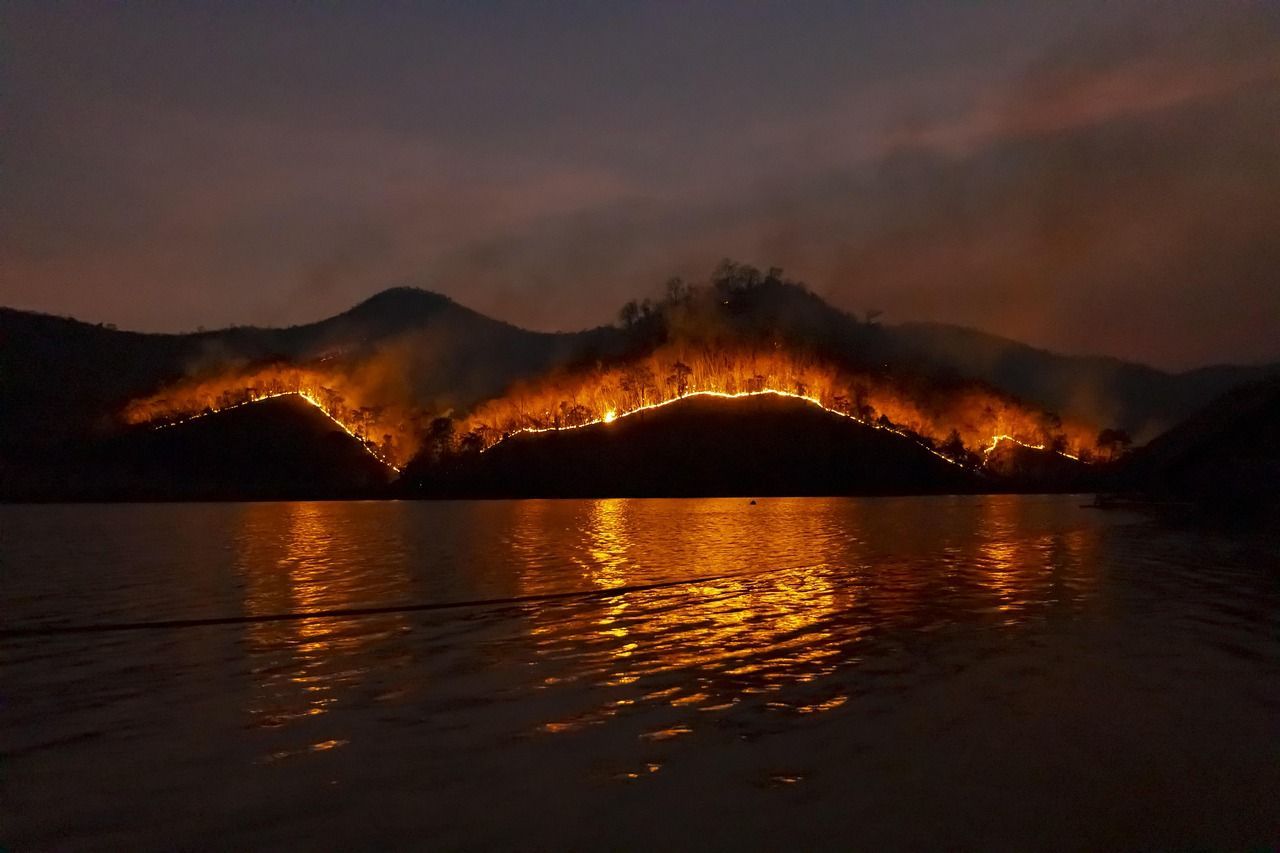
A nighttime view of a hillside ablaze, with flames reflected in the water below.
By Marlo Weekley September 9, 2025
Prescribed burns have been practiced for tens of thousands of years by Indigenous peoples across almost all continents.

Pink Flowers called bone seed, or Osteospermum, belonging to the daisy Asteraceae family
By Marlo Weekley June 12, 2025
Discover what real value means in today’s business world through the lens of permaculture and regenerative design.